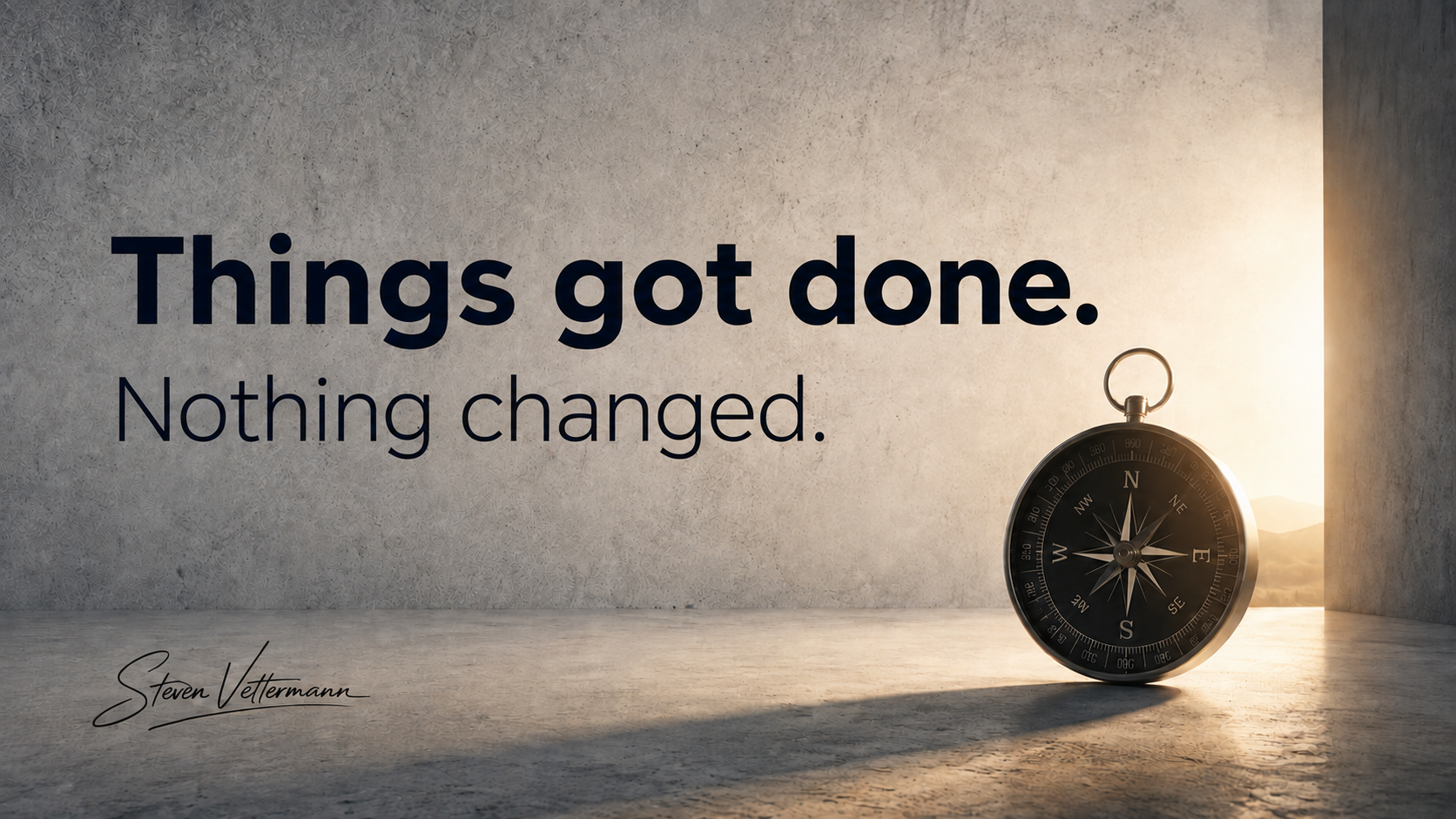
Things got done. Nothing changed.
When impact matters more than activity.
Something strange can happen over the course of a career.
You get better and better at getting things done. You learn how to manage projects, navigate organizations, deal with different interests, solve problems, and deliver results. With experience usually comes greater responsibility. Bigger projects. Harder decisions. More people relying on you to keep things running.
And at some point, an uncomfortable question can creep in:
Have I become really good at keeping a machine running without asking whether it’s still heading in the right direction?
Organizations rarely suffer from a lack of activity. Calendars are full, projects are underway, initiatives are being tracked, decisions are being prepared, and metrics are being reported.
Something is always happening.
But activity and progress are not the same thing. Neither are performance and impact.
When being busy becomes proof of success
Especially under pressure, that distinction can easily disappear.
When there is a lot to do, the obvious response is usually to do even more: make decisions faster, solve problems, prioritize tasks, finish projects.
That can look highly professional. After all, activity is remarkably easy to observe and measure. Completed tasks, milestones reached, and finished projects provide visible evidence that something is happening.
Whether any of it has actually made things better is often much harder to answer.
Organizations can become remarkably efficient at getting things done whose purpose no one questions anymore. Not because the people involved are doing a poor job. Quite the opposite. A high degree of professionalism can make an organization increasingly efficient at pursuing a direction it once chose.
But efficiency says very little about whether that direction still makes sense.
The question we rarely ask
Sometimes what organizations need less than another initiative is a moment of reflection. A brief interruption of the seemingly obvious logic of simply carrying on.
Are we still solving the right problem?
The question sounds harmless. In practice, it can become quite uncomfortable.
Because suddenly, the issue is no longer how well something is being implemented. It is whether what is being implemented still makes sense at all.
That can mean questioning projects people have grown attached to. Reassessing goals. Testing assumptions that may have been right months or years ago. Or acknowledging that a great deal of work already invested is not, by itself, a good reason to continue.
Leadership doesn’t always mean doing more
Perhaps this is precisely one of the more demanding tasks of leadership.
Not always making sure that more happens. Not responding to every uncertainty with another activity. And not confusing progress with the number of tasks completed.
But occasionally making sure that an organization stops and asks whether what it is doing so successfully is still the right thing to do.
Because sometimes the most important contribution is not getting more things done.
It is asking, in time, whether those things should still be done at all.
This reflection is based on my LinkedIn post “Things Got Done. Nothing Changed.” It was published on June 12, 2026.