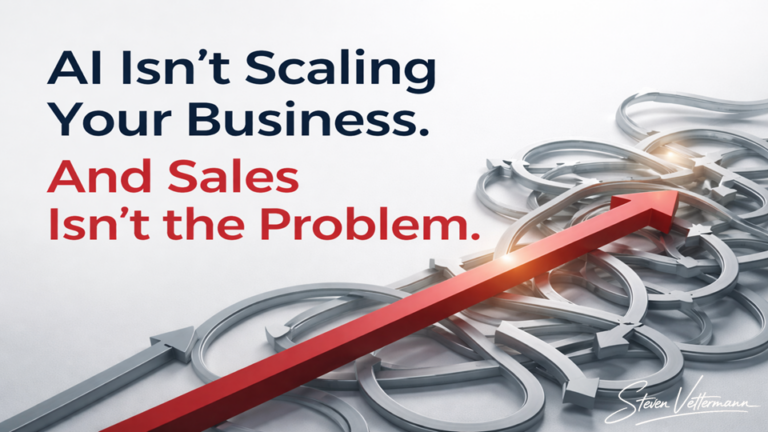
Your AI problem isn’t AI.
Most organizations approaching AI have a fairly straightforward expectation.
They want to move faster, become more efficient, reduce costs, and scale better.
That sounds reasonable.
Yet something interesting is happening inside many organizations. Despite significant investments in AI, cloud infrastructure, automation, and transformation programs, costs continue to rise. Quality issues become harder to control. Experienced employees leave or are optimized out of the system. And the people who remain find themselves carrying more complexity than ever before.
The usual explanation is that the technology is not mature enough yet.
I am not convinced.
What if the real problem is not the technology at all?
What if AI is simply exposing weaknesses that have been present in organizations for years?
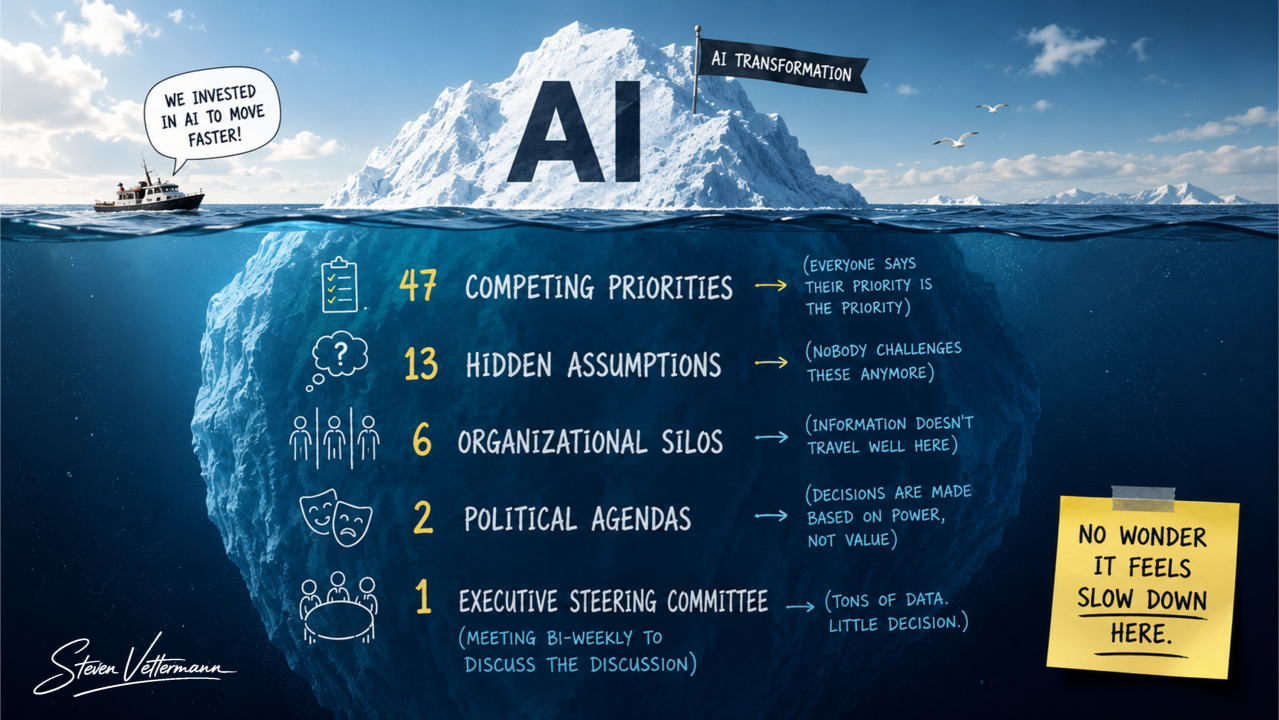
Because when I look at transformation initiatives, I rarely see technology creating the biggest risks. More often, I see organizations accelerating processes while leaving their decision-making logic untouched.
The technology changes. The operating assumptions do not.
And that is where things become expensive.
Under pressure, teams naturally focus on speed. Decisions have to be made quickly. Projects need to move forward. Targets have to be met.
The problem is that speed has a side effect. It makes invisible assumptions even harder to see.
- Teams begin acting on beliefs that nobody has explicitly discussed.
- Conflicting objectives remain unresolved.
- Feedback loops become shorter or disappear entirely.
- People start treating decisions as facts when they are actually assumptions wrapped in confidence.
The resulting AI paradox
Organizations become operationally faster while simultaneously becoming strategically less certain. They generate more activity, but not necessarily more orientation.
This is why I believe many transformation challenges are fundamentally decision-making challenges rather than technology challenges.
Modern organizations cannot eliminate uncertainty. In fact, AI will likely increase uncertainty in many areas because change happens faster than our ability to fully understand its consequences.
The organizations that thrive will therefore not be those that achieve perfect control. They will be the ones that learn how to operate effectively without it.
That requires a different mindset.
- Instead of treating contradictions as problems to eliminate, they become tensions to work with.
- Instead of waiting for complete certainty, decisions become testable hypotheses.
- Instead of asking who made the wrong decision, organizations ask which assumptions turned out to be wrong.
- And instead of optimizing exclusively for speed, they deliberately strengthen their ability to learn.
This sounds simple, but it has profound consequences.
Going beyond
Imagine a leadership team discussing a critical customer project. Everyone wants the project delivered quickly, at low cost, and with high quality.
Three objectives. One reality. Trade-offs are unavoidable.
Yet many organizations spend enormous amounts of energy pretending those trade-offs do not exist.
The more productive conversation is different.
- Which tension are we facing?
- Which priority are we consciously choosing?
- What assumptions are we making?
- And how will we know early enough if those assumptions are wrong?
The quality of these conversations often determines the quality of the outcome far more than the sophistication of the technology involved.
That is why I see the future competitive advantage of AI-enabled organizations not in prediction, automation, or even efficiency.
The real advantage lies in collective decision-making under uncertainty.
Because AI may help organizations process more information. But it cannot decide what matters. It cannot resolve conflicting priorities. And it certainly cannot provide leadership.
Those remain fundamentally human responsibilities.
Perhaps the most important question for leaders today is therefore not:
“How can we use more AI?”
But rather:
“Has our ability to make good decisions evolved as quickly as the technology we are deploying?”
The answer to that question may determine whether AI becomes a multiplier of value—or simply a faster way to amplify existing mistakes.
This reflection is based on my LinkedIn article “Your AI Problem Isn’t AI,” published on June 2, 2026.