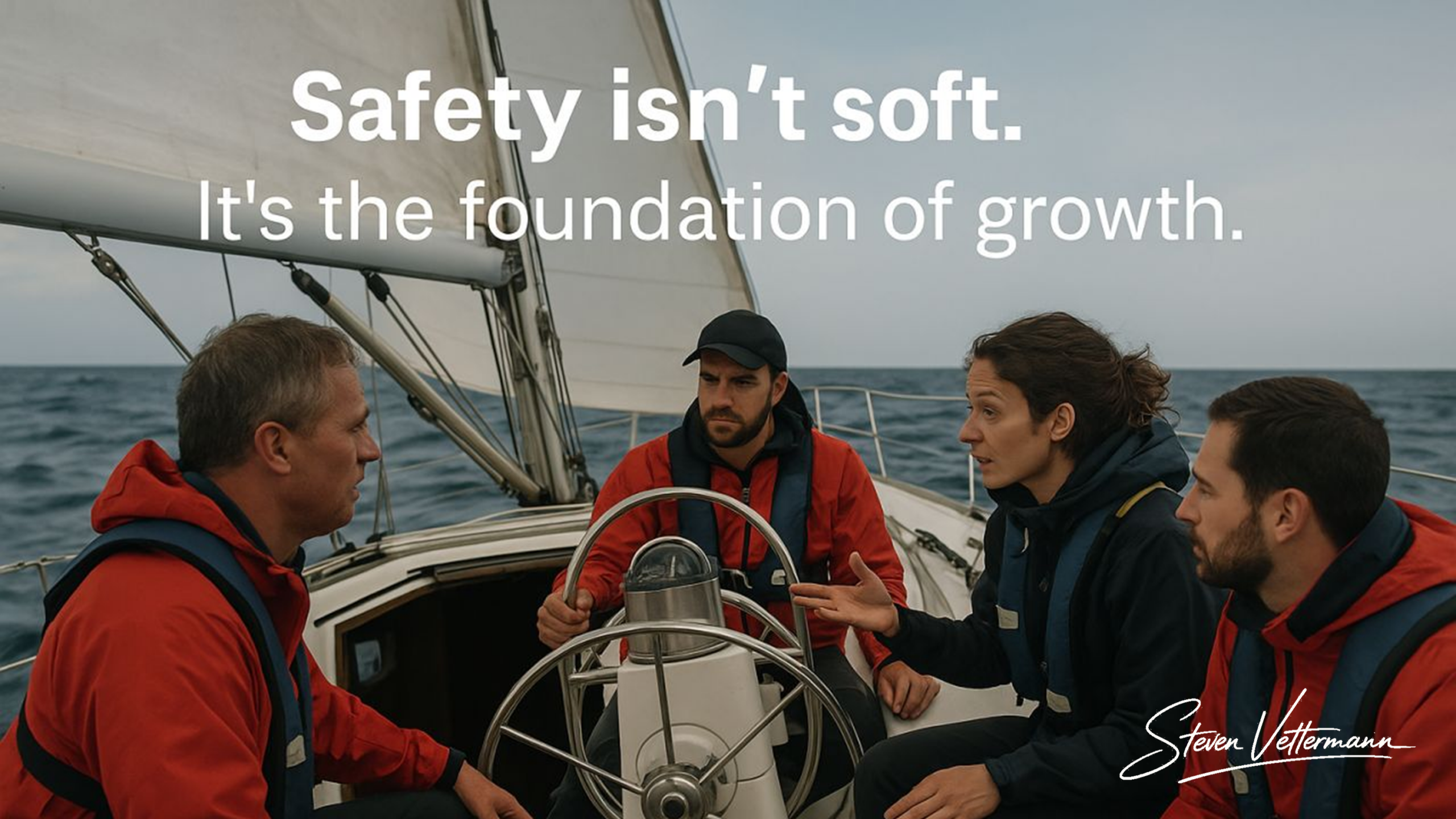
Psychological safety isn’t soft.
When speaking up has to be possible.
Some leaders internally roll their eyes as soon as they hear the words “psychological safety.” Here comes the soft stuff again.
But psychological safety isn’t about making everyone feel comfortable, avoiding conflict, or creating some kind of group hug.
Quite the opposite.
Psychological safety matters most when things get uncomfortable: when someone raises doubts, admits a mistake, challenges a decision, or tells a leader that they may be overlooking something.
I have often seen how professional the opposite can look. Everyone nods in meetings. The KPIs look good, milestones are being met, and reports are mostly green. No one objects, no one asks the fundamental question, no one unnecessarily disrupts the discussion.
From the outside, it looks like a well-functioning team.
Under the surface, something very different may already be happening. People see risks but stop raising them. They have doubts about decisions but keep them to themselves. Not necessarily because anyone explicitly told them to stay quiet. Often, they have simply learned that speaking up costs more than staying silent.
And silence is remarkably easy to mistake for agreement.
What people don’t say is missing from the organization
A few years ago, someone on my team became unusually quiet. There was no specific reason for a performance or goal-setting conversation. I simply asked him how he was doing.
After a long pause, he said something along the lines of:
“I don’t know anymore whether what I’m doing is actually of any value to the team.”
That sentence stayed with me.
Because technically, everything was fine. Tasks were being completed, results delivered, the usual mechanisms were working.
On a human level, we had already grown much further apart than I had realized.
And that was also my responsibility as a leader.
That is exactly why I find the term “soft skill” misleading. Psychological safety isn’t a nice addition for times when the real work has already been done. It directly affects what information reaches an organization in the first place.
A risk doesn’t disappear because no one raises it. A false assumption doesn’t become true because no one challenges it. And a bad decision doesn’t improve because everyone in the meeting nods.
Psychological safety therefore doesn’t mean harmony.
A psychologically safe team can have highly contentious discussions. People can disagree, challenge positions, and work through conflicts. What matters is whether they can reasonably expect that asking an uncomfortable question, admitting a mistake, or expressing a dissenting view will not automatically have personal consequences.
Leadership shows in the response
Whether that space actually exists is determined less by mission statements or leadership training than by small moments in everyday work.
What happens when someone challenges a leader’s decision? How do we respond to the person who reveals a mistake before it becomes a bigger problem? And what happens to the person who says in a meeting what many have long been thinking but no one wants to hear?
Teams watch these moments very closely.
A single reaction can reveal more about how welcome openness really is than ten invitations to please give honest feedback at any time.
That makes psychological safety something very concrete. It affects whether assumptions are challenged, mistakes become visible early, conflicts can be worked through, and an organization can actually learn from different perspectives.
This is not the soft side of leadership.
It is the question of how much truth an organization can handle when that truth becomes uncomfortable.
This reflection is based on my LinkedIn post “Safety Isn’t Soft.” It was published on November 5, 2025.