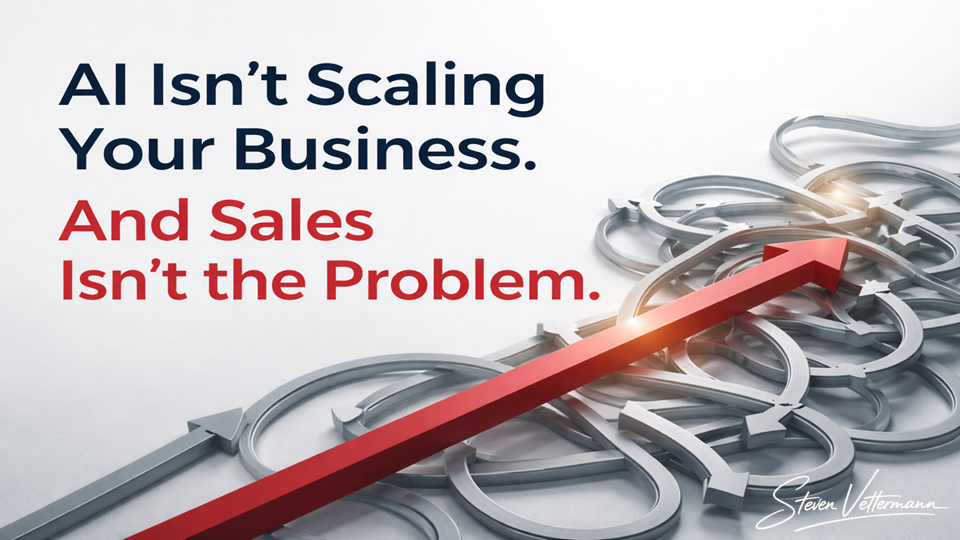
AI isn’t scaling your business. And sales isn’t the problem.
In business, it’s all about assumptions.
I have worked closely with organizations that were introducing AI into their products and operations. The pattern I observed was remarkably consistent:
- The technology worked.
- The strategy looked convincing.
- The ambition was clear: scale, differentiation, efficiency, new market segments.
And yet, after a short period of initial enthusiasm, friction emerged. Decisions slowed down. Responsibility became diffuse. Sales blamed product. Product blamed customization. Leadership debated positioning.
The organization felt the tension, but no one could clearly articulate why.
My observations
In many cases, the first reaction was predictable. Companies attempted to solve the issue with visible, logical measures: hire more sales capacity, sharpen positioning, refine pricing, add new features, optimize a workflow.
All reasonable steps. But almost always aimed at the surface.
What I came to understand is this:
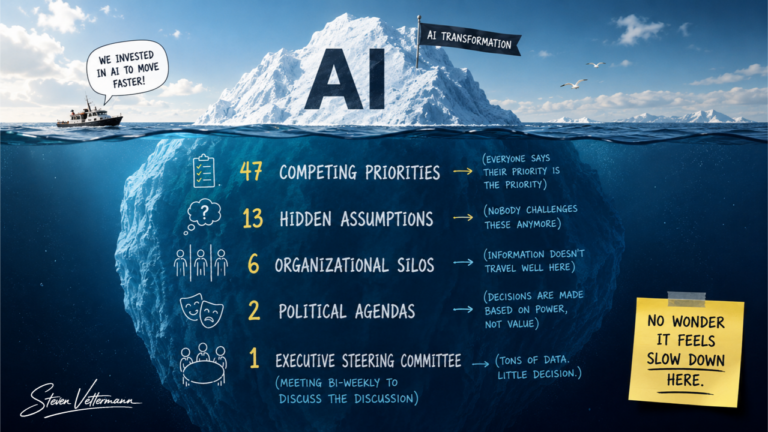
AI does not create chaos. It exposes the existing chaos.
AI increases the structural pressure on organizations. It raises the demands for clarity around product boundaries, decision authority, governance, and strategic intent. It forces organizations to confront whether their structures actually support their ambition.
Many companies continue to operate with a deeply ingrained project logic while publicly committing to product scalability—project logic vs. product logic.
They reward customization while speaking about standardization. They expect speed, yet maintain diffuse decision rights. They aspire to scale, but structurally reproduce individual exceptions.
AI amplifies these contradictions.
From my perspective, when AI becomes part of the value proposition, the organization can no longer hide structural incoherence behind successful individual projects.
The friction that appears is not a technical problem. It is a structural signal.
Transformation
In my work, I have found that progress becomes possible when three layers are addressed explicitly and in alignment.
1. Meaning
Leadership must articulate clearly what role AI plays in the value proposition. Is it a feature, a differentiator, or the product core?
Without shared meaning, the organization will interpret strategy in divergent ways.
2. Assumptions
Every organization operates based on implicit beliefs that guide decisions.
For example, the belief that customization always takes precedence over standardization. Or that scaling must never endanger existing client relationships. Or that AI can support but should never fundamentally reshape the product architecture.
As long as these assumptions remain unexamined, they silently limit strategic options.
3. Structure
Decision authority, ownership of the product core, criteria for deviation, and governance mechanisms must be explicit.
If no one clearly owns the product core, it will gradually dissolve under project pressure. If conflicts between standardization and customization are not governed by defined principles, they will be resolved politically.
Scalability is not achieved by adding features.
Scalability is achieved by aligning meaning, assumptions, and structure.
AI is not primarily a technology challenge. It is a leadership challenge.
Organizations that are willing to examine their decision architecture and align it with their strategic ambition significantly increase their capacity to scale.
Organizations that avoid this work tend to integrate AI into existing patterns and thereby accelerate their own limitations.
AI does not automatically create clarity. But it demands it.
If you are navigating similar friction in your organization and sense that the problem may not be where everyone is currently looking, I would be glad to continue the conversation.
This reflection is based on my LinkedIn article “AI Isn’t Scaling Your Business. And Sales Isn’t the Problem.,” published on March 2, 2026.