Leadership begins where certainty ends.
Many leaders experience their days as a constant barrage. Decisions, alignment meetings, escalations, new demands – and the persistent feeling that, despite all the activity, they are not making progress where it really matters.
Under that kind of pressure, we tend to fall back on what has worked before. It takes different forms, but the direction is often the same: plan more, manage more closely, make more decisions yourself, solve more problems.
That can work for a long time. Eventually, though, leadership becomes exhausting – and, at the same time, less effective. Not because this way of leading is fundamentally wrong, but because it evolved for a world that was more predictable.
Leading under uncertainty requires something different: providing orientation, enabling and expecting responsibility, making decisions, observing their impact, and adjusting when necessary.
That is what this article is about.
Just another day
The day starts with a plan. Maybe even with just three things that really matter today. Then the first message arrives. A customer urgently needs a decision. In the next meeting, a project is stuck. After that, someone needs your approval. A colleague asks for five minutes, which turns into twenty. An issue you thought had been resolved long ago suddenly lands back on your desk.
By noon, the calendar is full. In the afternoon, a question turns into an escalation. And sometime in the evening, you are sitting in front of your computer, having worked all day, wondering why you barely made progress on the things that actually mattered.
The strange thing is: you were not idle. Quite the opposite. You made decisions. You helped. You prioritized. You solved problems, had conversations, accelerated things, and kept others from making mistakes.
Just another day. Nothing unusual. You get used to it.
And yet there is that uncomfortable feeling: “This isn’t really what I thought I was here to do.”
I know that feeling well. And working even harder does not make it go away.
Under pressure, we rarely become more modern
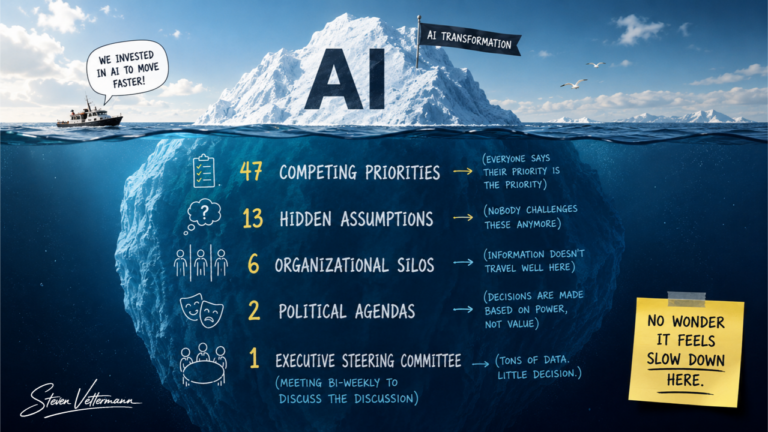
Leaders today face a constant stream of competing demands. Costs need to come down. Customers need to be more satisfied. Transformations need to move faster. People need to be developed. Operational problems need to be solved. And somewhere in between, we are also supposed to make something useful out of AI. Preferably all at the same time.
Under stress, people respond in a surprisingly rational way: we fall back on what we know and what we are good at.
In many organizations, that still means planning in greater detail, managing more closely, asking for more information, and pulling decisions upward. And when things become really critical, we step in ourselves.
That is not necessarily a character flaw. It is human. And often, it is learned professionalism.
Industrial organizations in particular have spent decades optimizing for stability, efficiency, and repeatability. That made them extraordinarily successful. Leadership, accordingly, meant deciding, directing, and controlling.
The problem is that the world in which this logic evolved no longer exists.
Plans are overtaken by developments that could not have been anticipated when they were made. Decisions have to be made despite missing information. Small changes in one part of a system can create unexpected consequences somewhere else. Clear-cut answers are becoming increasingly rare.
And precisely when that happens, we often try to fight uncertainty with more of what was designed for predictability.
When leadership moves closer and closer
It usually starts innocently enough. You just want to take a quick look at the presentation. You join an additional project meeting because things are getting difficult. You ask to be copied on important emails.
The next time a decision comes up, the team checks with you again. After all, you know the context. You have experience. And quite often, you really can make the decision faster.
So it works. At first.
Until more and more decisions start landing on your desk. Until people learn which things they had better double-check before acting. Until you become frustrated that no one seems willing to take responsibility – while the organization has simultaneously learned that taking responsibility without your reassurance is risky.
That is the uncomfortable side of micromanagement. It does not necessarily begin with a desire for control. It can begin with a sense of responsibility. And that is exactly what makes it so persistent.
The greater the uncertainty, the closer leadership moves to the operational work. The closer it moves, the more decisions converge on the leader. The more decisions converge there, the greater the pressure becomes.
Eventually, the leader becomes the bottleneck. Not because they are doing too little, but because they are doing too much.
The decision had been made. Technically.
There is another response to overload that looks almost like the opposite. You decide.
A typical meeting. The issue has been discussed at length. Different interests are on the table. People have wrestled with it, perhaps even argued. Eventually, there is a decision. Relief. Next topic.
Four weeks later, it turns out that different parts of the organization understood the decision differently. One part was implemented, another was not. Someone had good reasons for deviating from what had been agreed.
And whether any of it actually produced the intended effect? Nobody really knows.
The decision had been made. It just had not been led.
In situations like these, I sometimes wished I had heard a boss say more often: “Good. This is what I will measure you – and myself – against.”
Not as a threat. Not as a way to catch someone making a mistake later, but because a decision is, initially, nothing more than a reasoned assumption about what should happen. Only its impact tells us whether it was a good one.
Leadership does not end with a decision
That headline sounds obvious. Yet in everyday organizational life, it is surprisingly easy to forget.
We invest enormous amounts of energy in making decisions and comparatively little in systematically observing their effects. Under uncertainty, that should be exactly the other way around.
What were we trying to achieve? What actually happened? What are we seeing with the customer, in the project, within the team, or in the market? Which of our assumptions turned out to be valid? Which did not? What do we need to change?
With questions like these, leadership begins to shift.
Not from planning to having no plan. Not from control to laissez-faire. And certainly not from expertise to ignorance.
What changes is what we use these capabilities for. Planning no longer describes only what should happen; it also makes explicit our assumptions about what might work. Control focuses less on people and more on the impact being created. And expertise is no longer used only to provide answers. It contributes to a shared understanding of the situation.
Maybe that is the real relief
The old capabilities do not disappear. They simply take a different place.
Maybe that is the real relief.
Anyone who equates leadership with certainty carries an almost impossible expectation: you should know the right answer, anticipate risks early enough, make good decisions, and keep the organization under control. And if something goes wrong, apparently you should have looked more closely.
In today’s complex and uncertain world, that simply does not work reliably.
But the alternative is not to give up responsibility. Quite the opposite. It is to understand responsibility differently.
A leader does not need to know with certainty what will be right six months from now. They need to make clear what matters now. They need to make decisions even while questions remain unanswered. They need to leave responsibility where the necessary knowledge resides. And they need to stay attentive enough to notice when reality begins to contradict an assumption they have made.
That requires inner stability, a systemic understanding of the organization, and shorter cycles of learning and decision-making.
It is demanding. But perhaps it is less exhausting than trying to personally ensure that everything, everywhere, goes right.
Leadership means orientation, not certainty
The longer I have experienced leadership, the more important the second half of that sentence has become to me.
Because as long as the right path is largely known, cause and effect are reasonably clear, and decisions can be derived from experience or expertise, leadership is comparatively straightforward. Perhaps demanding, but predictable.
It becomes interesting when exactly that stops working. When several paths seem plausible. When important information is missing. When a decision has to be made before its consequences can really be known.
At that point, a leader can no longer provide certainty.
But they can provide something else. They can make clear what matters. They can stand behind a direction. They can make decisions and take responsibility for them. They can trust others to act within that orientation. And they can remain attentive enough to recognize when reality shows that an assumption no longer holds.
Perhaps leadership really does begin where certainty ends.
Not because knowledge matters less there, but because knowledge alone is no longer enough.
This reflection is based on my LinkedIn article “Leadership Begins Where Certainty Ends,” published on August 27, 2026.