Does Your AI Strategy Start in IT? Then You Will Fail.
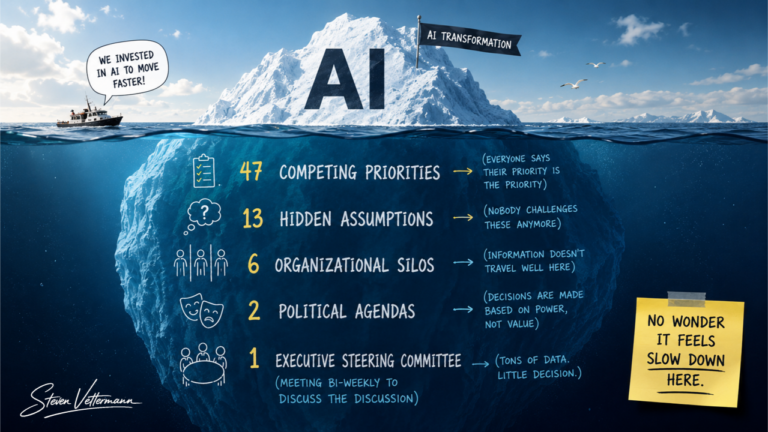
AI transformation is not a technology project. Treat it like one, and you can get the technology right – and still end up with the wrong result.
The pilot works. The models deliver useful results, the architecture is in place, and the first users are happy. There may even be impressive numbers showing how much time has been saved. Everything seems to be going according to plan.
And yet, the AI transformation may already be on its way to failure. Not because IT did anything wrong, but because it was given a task that was never purely an IT task in the first place.
The problem often starts surprisingly early. AI is perceived as a technological challenge – so it initially ends up where technology belongs. Requirements are defined, vendors compared, architectures designed, and the first use cases launched. That makes sense. But it easily creates the impression that implementing the technology means the transformation has begun.
In reality, the difficult questions often only start once the technology works.
Take an AI system that supports employees in making a decision that previously relied heavily on human expertise. It analyzes data, identifies patterns, and makes a recommendation. Technically, it works extremely well. But can an employee simply follow that recommendation? Do they need to verify it? What happens if their own assessment differs? Who is responsible if the recommendation turns out to be wrong? And what changes if the system consistently produces better results than the most experienced person on the team?
Suddenly, this is no longer about AI. It is about responsibility, roles, decision-making authority, processes, and capabilities. Perhaps even status and power.
That is exactly why AI transformation cannot be reduced to technology. It always affects at least three interconnected dimensions: IT, organization, and people.
IT creates technological possibilities and ensures data availability, integration, security, and scalability. The organization determines how work is distributed, where decisions are made, and who carries responsibility. People need to understand, assess, decide, and act within that system.
Organizationally, these three dimensions can be separated. In reality, they cannot be changed independently of one another.
AI may, for example, make a decision significantly faster. But if the existing process still requires three levels of approval because that is how responsibility has been distributed, little has been gained. Change the process, and you change responsibilities. That, in turn, changes roles, capabilities, and expectations. What appeared to be a technology project has long since become organizational development.
When a Successful Pilot Becomes the Problem
A successful AI pilot is therefore no proof of a successful AI transformation. A solution may work extremely well in a protected environment. Once it is scaled, however, it encounters established processes, varying data quality, conflicting priorities, regulatory requirements, and existing decision-making structures.
What made perfect sense within the pilot team can suddenly become contradictory within the wider system. Parallel processes and workarounds emerge, decisions are double-checked, and responsibilities remain unclear.
The technology still works. The organization just does not work with it.
That is not an argument against pilots or quick wins. Experimentation is essential, particularly with AI. It becomes dangerous when “We need to start learning” quietly turns into “We need to implement something as quickly as possible.”
A lack of clarity does not disappear with speed. If it is unclear what problem is actually being solved, how impact will be measured, what data and capabilities are required, and how responsibility will be distributed in the future, those questions will return later. By then, however, they tend to have different names: rework, conflict, delay, or lost trust.
AI Transformation Is a Leadership Task
An IT department can create excellent technological conditions. But it cannot decide on behalf of the organization what the company wants to achieve with AI, what responsibilities leaders should carry in the future, or how human and machine decisions should relate to one another.
These are not technical questions. They are leadership questions.
So perhaps the first question before your next AI project should not be: What technology do we need?
But rather: What are we setting in motion in our organization with this technology?
Because when you pull on technology, you inevitably move organization and people as well. Whether you planned to or not.
This article is based on my LinkedIn post “You fail if you treat digital transformation as an IT project” from April 9, 2026.